 |  |  |
| | Home | World of Noh | Music |  |



















 Music
Music
| Other Roles | Stage | Noh Masks | Props | Vocal | Music | Noh Dance | Movement Patterns |
| Costumes | What is Kyōgen |
The music of noh is played by the hayashi. As each part of noh is an integral piece of the whole, the hayashi is not considered to be accompanying the shite or ji-utai, but is instead playing with them, equally.
Shibyōshi
The hayashi is made up of four instruments: fue (flute), kotsuzumi (shoulder drum), ōtsuzumi (hip drum), and taiko (stick drum), these four instruments are also known as the shibyōshi. Most of the musicians are from an established family in the noh world. And while each musician has studied all the instruments intensively, they specialize in only one and will only perform that one instrument in their career in noh.
The leader of the hayashi in performance is the taiko, however in noh in which the taiko is not appearing, daisho-mono, the ōtsuzumi is considered the leader. Interestingly, the sound of hitting the drum is not the only way to keep rhythm in noh. The drummers also use their voices to create drum calls or kakegoe which are used before hitting the drum to help adjust the timing and drive the rhythm. The sounds, “yo, ho, yo-ii, ii-ya” and others can be heard from the drummers while they are playing.
Fue (Flute)
The transverse flute used in noh is made of bamboo and called the fue or noh-kan. And while among the four instruments it is the only one with a melody, in noh, rhythm is in some ways more important than melody. It is this emphasis on rhythm rather than melody that makes the fue unique.
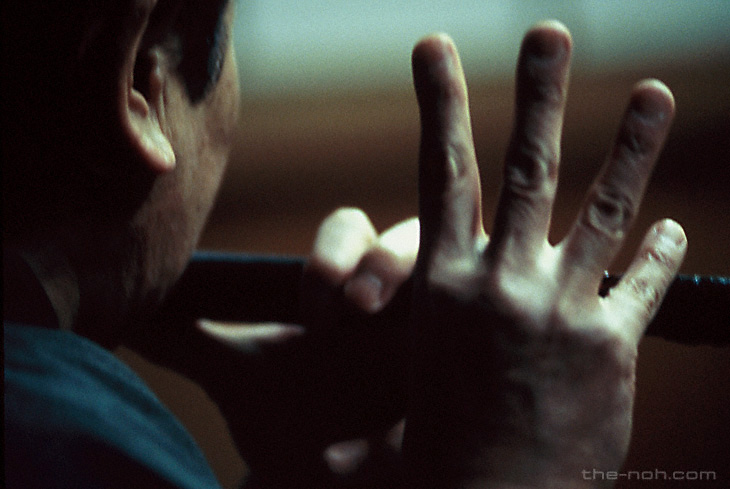
There are two basic playing modes for the noh-kan. Ashirai-fuki, is an unmatched playing mode, where the noh-kan plays independent of the rhythms of the drums. Awase-fuki is a playing mode where the noh-kan follows the rhythm of the drums.
In order to de-emphasize the melody of the flute, every noh-kan is made slightly differently by varying the length of the body as well as the positioning of the fingering holes. This in turn makes the melodic range and the quality of the sound different from instrument to instrument. In performance, the noh-kan is striving to create a sound that will ornament the singing and to help express the feelings of the shite.
The current schools of fue-kata or noh-kan players are the Issō, Morita, andFujita.
Kotsuzumi (Small hand drum)
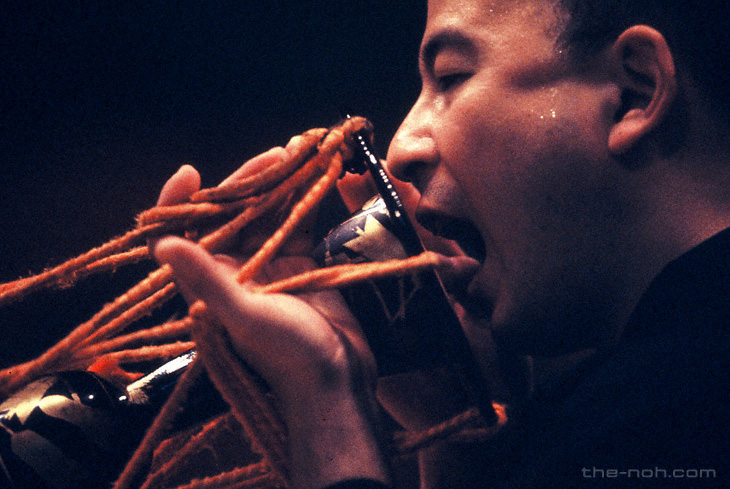
The kotsuzumi (lit. small drum) is a popular instrument that is one of the components creating the rhythms of noh. Held in the left hand at the right shoulder and struck with the right hand, the pitch of the drum can be adjusted through the squeezing and releasing of the shirabeo (chords used to hold the drum heads onto the hour glass shaped body). Through this manipulation of the shirabeo, four distinct sounds can be made. In order to create a beautiful sound, the drum-heads must be kept slightly moist. To maintain this moisture during a performance, a drummer will diligently either blow hot air on the drum head or more directly, apply saliva to small pieces of paper that have been stuck to the rear drum head.
The current schools of kotsuzumi-kata are the Kanze, Kō, Kōsei and Ōkura.
Ōtsuzumi (lit. large drum) / Ōkawa (lit. big skin)
The ōtsuzumi can be considered the leader of the two hand drums. The shirabeo (chords used to tie the drum heads to the body) are tied very tightly and there for the sound produced is sharp and hard. The variation of the sounds for this drum are determined by the strength of the hit and whether the drummer’s hand remains of the drum after striking it. It is held in the left hand and rests on the left hip while being struck by the fingers of the right hand. To produce the desired sound the drum heads need to extremely dry. This is achieved by heating the drum heads over charcoal for about one hour before performances. The contrasting sound of the soft kotsuzumi with the sharp ōtsuzumi creates a harmony on stage.
The current schools of ōtsuzumi are the Kadono, Takayasu, Ōkura, Ishii, and Kanze.
Taiko (stick drum)
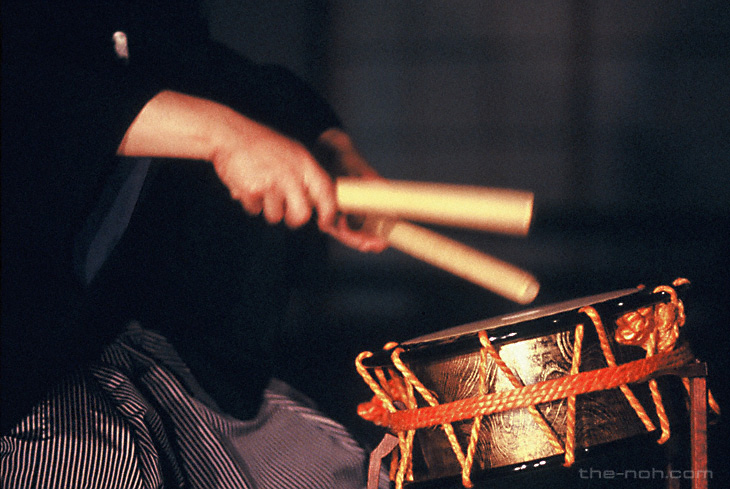
The taiko is a barrel-type drum that sits on a wooden stand and is hit with bachi (wooden drum sticks). There are two overall methods of playing taiko. By leaving the bachi on the drum head after striking, the drummer can dampen the sound; or to create a resonating sound, large, medium or small strokes can be used. By using the two bachi to create complicated, driving rhythms, the taiko can add great effect to noh. Therefore, it is often used to accompany characters of extreme grace or vibrant characters such as gods, demons or possessed spirits. Still, as the sound of the taiko is so powerful, even in noh where it does appear, it almost never plays during the whole piece. Usually it only plays during the second half.
The current schools of taiko are the Kanze and Komparu.