
 |  |  |
| | Home | World of Noh | Noh Dance |  |



















 Noh Dance
| Other Roles | Stage | Noh Masks | Props | Vocal | Music | Noh Dance | Movement Patterns |
| Costumes | What is Kyōgen |
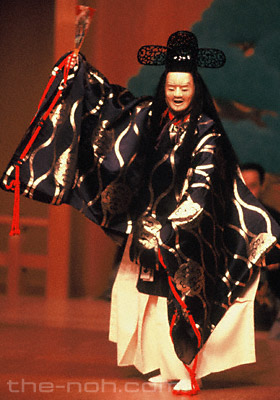
The mai (dance) of noh, along with the musical elements of song and instrumental music are components of this comprehensive art form. Mai can be called the foundation of the form. The dance of noh is not simply the expression of the body moving through space, it has a much deeper meaning. When one is said to perform noh, one is said “to dance noh.” In a broad sense of the word, mai expresses much more than just the music and the movement, it somehow encapsulates the comprehensive nature of noh.
The word mai is also used for a specific dancing section of a noh. These mai, with names like chū-no-mai or jo-no-mai, feature the flute and the drums playing in a rhythmic fashion, timed to coincide with the shite’s dance.
Types of Mai
Depending on whether the character is male, female or other, and depending on the category of noh, shūgen-mono (god-theme), shura-mono (warrior-theme), or kazura-mono (woman-theme), the mai in a noh will be different. In many ways, the melody and rhythm of the flute in a mai are responsible for setting the tone. Below is an introduction to the principle mai of noh.

- Chū-no-mai (Medium tempo dance)
- The chū-no-mai is a medium tempo dance that can be said the other mai are modeled from. There are two versions of the chū-no-mai: daisho-mono is just with the two hand drums and the flute and taiko-iri which utilizes all the instruments. In a genzai-noh a female character would generally perform this mai. Yuya, Matsukaze and Kochō are examples of noh which include the chū-no-mai.
- Jo-no-mai (Slow tempo dance)
- An extremely slow-tempo dignified mai. Jo-no-mai can be performed with or without taiko. Types of characters who dance this are: shirabyōshi (traveling female dancers wearing male attire), traditional female dancers, ghosts of noblewomen, female spirit or deity. Hagoromo, Izutsu and Eguchi are noh that include the jo-no-mai.
- Otoko-mai (lit. man dance)
- This is a fast tempo, lively, strong dance used for male characters living in the present and therefore not wearing a mask, or perhaps to convey a celebratory feeling. Ataka, Kogo, and Kosodesoga are noh which include the otoko-mai.
- Kami-mai (lit. god dance)
- The kami-mai, is performed in waki-noh (first category) by male deities. It is an extremely fast tempo dance performed with gallant dignity. The taiko is included in the this mai. Takasago, Yōrō and Yumi Yawata are noh which include the kami-mai.
- Gaku (lit. enjoyment)
- Drawn from the music and dance of the imperial court, gaku is used in noh which have a Chinese theme and for noh in which an imperial musician is the shite. The dance starts slowly, but gradually builds into a quick tempo, stately mai. This mai includes taiko. Tenko, Kantan and Fujidaiko are examples of noh which include gaku.
- Kagura (lit. god enjoyment)
- Kagura is a dance performed by a female deity or a Shinto priestess. Its origins are said to be from Shinto ritual dance and the flute plays a melody that was adapted from the kami-mai. Depending on the school, the shite may hold a Shinto wand while dancing. The taiko is included in kagura. Miwa, Makiginu and Tatsuta are examples of noh that include kagura.
Apart from the above examples other mai include banshiki-hayamai, kakko, kyū-no-mai, and ha-no-mai. The mai-bataraki, in which a dragon, goblin or the like display its power; or the kakeri, which displays the struggles of a tormented soul, while not considered as mai, are still a kind of dance.
Depending on the heavy or light nature of the noh, one of these many mai are chosen to best represent the beauty of the form and the freeness of the expression.
The Difference Between “Mai” and “Dance”
Generally speaking, in Japanese within the noh world, the expression “noh wo odoru” (to dance noh) or “noh no odori” (the dance of noh) is not used. Rather another word, mau or mai is used. It has the same translation, but the meaning is quite different. In fact the word buyō, also meaning dance, is a combination of the two characters mai and odori, but how really are the two words different, mai and odori. If you look in the dictionary, the word odori somehow relates to dancing in rhythm, jumping, and using your hands and feet to articulate. Mai on the other hand conjures images of sliding feet and “going around”.
From long ago the distinction between the two was made, but exactly when and where that happened is unclear. There are indeed noh in which stomping to a rhythm and jumping are used, but for some reason, the word mai has remained as the word used to describe the movement in noh.
In addition Kagura, Imayō, Rōei, Ennen-no-mai, Kuse-mai, all stemming from ancient traditions used the word mai to describe the movement. It seems as if because of noh’s connection with those older traditions, they have remained attached to the use of the word.

