

|
||||||||||||||||||||||||||||||
|
|
|||||||||||||||||||||||||||||
![]() |
Utai 友枝喜久夫 粟谷新太郎 and more © TOSHIRO MORITA |
The music of Noh is composed of utai (vocal) and hayashi (instrumental).
Utai is performed by shite-kata. Hayashi is performed by hayashi-kata (instrument players).
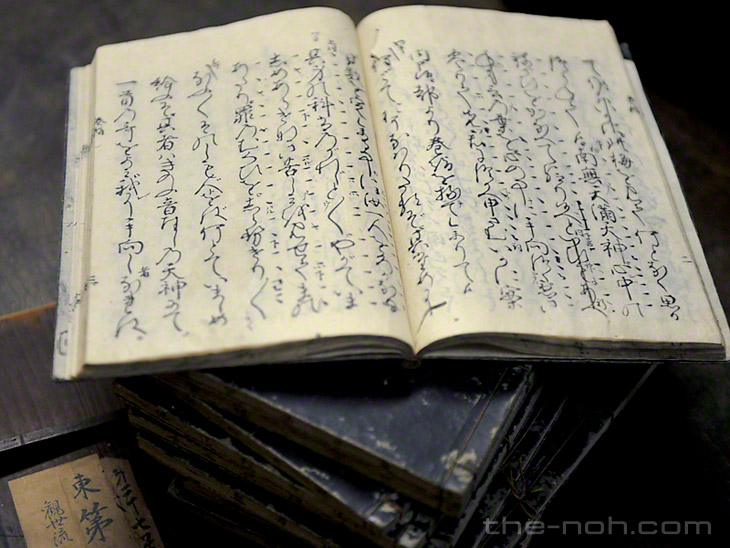
Utai is the vocal music with the Noh dance.
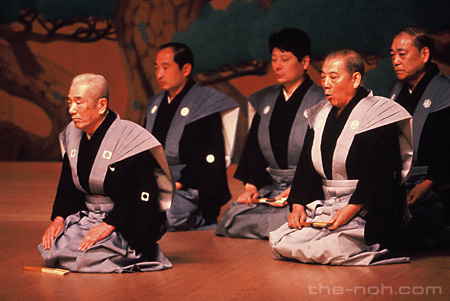
The Noh drama progresses with utai (vocal) by an actor such as shite or waki. Jiutai are group reciters, like a chorus group, who describe the events and scenery and recite the emotion of the character as the narrator. Jiutai does not show up as a character on the stage.
Jiutai is performed by the members in shite-kata. They are seated in two rows, front and back, in the space called jiutai-za. The reciter sitting at the center of the back line is called "jigashira" (the leader of the group reciters), and he serves a central role in the chanting.
Unlike Western music, there is no absolute musical scale in utai. Tuning is determined by shite and jigashira (the leader of the group reciters); it is a flexible vocal music. Jiutai-kata is performed by multiple members, but unlike the chorus in Western music, they do not create harmony. Although pitch of their voice is tuned up, each member in jiutai recites in individual voice. Jigashira sets appropriate tone for the chorus, controls the timing, and integrates the entire reciting.
The rhythm of utai is seven-and-five syllable meter (twelve letters) and chanted in eight beat. "Hiranori" is the standard rhythm of utai. "Chūnori" is a rhythm that is faster than the standard, and "ōnori" is the one slower than the standard. These three rhythms together are called "hyōshi-ai." On the other hand, in "hyoshi-awazu" the reciters chant in an off-eight beat.
Vocalization of utai takes two reciting styles. "Tsuyo-gin (strong reciting)" is a vocalism with solemn and valiant tone, while "yowa-gin (weak reciting)" is melodic and sentimental.
Hayashi-kata are in charge of the instrumental parts of the Noh music. They are not accompanists of dance and utai (vocal). They structure the music of Noh on an equal footing with shite and jiutai.
Hayashi-kata is composed of four musical instruments: fue (Nohkan: flute), kotsuzumi (small hand drum), ōzutsumi (also called ōkawa: large hand drum), and taiko (drum). These four instruments are called shibyōshi. Each instrument is played by a specialist, and individual families who have specialized in a particular instrument have inherited sophisticated skills and the style of performance from generation to generation. In Noh dramas, one person plays one role and does not perform a non-assigned part.
In performances, the drum leads the beats. In a performance with hand drums, which is called "daishō-mono," the large hand drum leads the small hand drum. The percussionists not only play the instruments but also make calls, such as "hatz," "yea-ah," "hahon'nyoh," and "hoh." These calls are for adjusting the timing and propelling the progress of the performance.
The flute (Nohkan) used for Noh performances is made of bamboo. Although it is the only instrument which can create melody within the shibyōshi (four musical instruments), Nohkan (flute) in Noh mainly plays rhythms instead of melody. Such style of flute performance is unique to Noh.
![]() |
Fue 寺井久八郎 © TOSHIRO MORITA |
The performance style of Nohkan (flute) includes "ashirai-fuki," which does not meet with the rhythm of vocal and the percussion but makes the sound elastic with propriety. Another style is "awase-fuki," which plays with the rhythm of the percussion.
Since their performance does not emphasize melody, each Nohkan (flute) is different in length and has holes located in different positions. Since they are not tuned, each flute also has different pitch and tonal scale. The performance of Nohkan aims to modify utai (vocal), symbolically expresses the emotion of the protagonist, and creates a particular atmosphere.
The existing schools of fue-kata include the Isso school, Morita school, and Fujita school.
This popular type of hand drum also governs the rhythm. The player of the small hand drum grabs the string called shirabeo in his left hand, places the instrument on the right shoulder, and hits it in the right hand. By adjusting the string (shirabeo), the player can make four different tones. Unlike the large hand drum, in order to make beautiful tones, moisture is significant for the small hand drum skin. The player therefore keeps breathing or putting saliva on the drum skin and continuously pays attention to the condition of the instrument.
![]() |
Kotsuzumi 成田達志 © TOSHIRO MORITA |
The existing schools of kotsuzumi-kata include the Kanze school, Kō school, Kōsei school, and Okura school.
The large hand drum also governs the rhythm. Since the strings called shirabeo of the large hand drum are tight, the sound is determined by the strength of the strike and whether a player hold the drum skin after he strikes it. The player places the drum on his left knee and hits it with the fingers of his right hand. The skin of the large hand drum needs to be dried to make a strong sound. For this, the drum is roasted with charcoal fire for one hour before the performance. With this maintenance, the large hand drum creates contrasting sounds with the small hand drum, which creates soft sounds, and the two different types of hand drums resonate in well-balanced manner.
The existing schools of ōtsuzumi-kata include the Kadono school, Takayasu school, Okura school, Ishii school, and Kanze school.
The drum is put on the floor with a stand and beaten with two drumsticks. There are two styles of performance. One is the technique of holding the drum skin by drumsticks to prevent the drum from resonating. The other way is to beat the skin with different strengths to make strong, medium, and small sounds. Since a player uses two drumsticks, he can trill and make complicated rhythms, which add gorgeousness to the Noh drama. It is therefore often used to describe gracious art performances or the movement of superhuman characters, such as gods, oni (demon), and spirits. Even for a Noh drama with a drum performance, it hardly happens that drum is played throughout a drama; it is typically played in the second half of a drama.
![]() |
Taiko 助川治 © TOSHIRO MORITA |
The existing schools of taiko-kata include the Kanze school and Komparu school.
| Terms of Use | Contact Us | Link to us |
Copyright©
2010
the-NOH.com All right reserved.